Wildfire Resilient Landscapes
Advancing research, policy, and practical solutions to restore ecological resilience across human and natural landscapes.
New Working Paper Series: Housing Systems, Risk, and Stability
I am developing a series of working papers examining homelessness through a systems, risk, and policy design lens.
The Structural Gap in Housing Systems: System Misalignment and Barriers to Housing Stability
This paper examines how misalignment between program design, funding continuity, and housing market conditions creates a structural gap in the transition from temporary placement to long-term housing stability.
Predictable Instability: A Systems Analysis of Misaligned Responses in Homelessness Policy
Building on this foundation, this paper explores how current response models produce recurring patterns of instability when short-term interventions are applied to structural conditions. It introduces a framework distinguishing shock-driven and structural risk, with implications for system performance and outcomes.
Toward System Alignment: A Framework for Risk-Based Housing Policy and Forecasting
This forthcoming paper will focus on policy design, introducing a dual-track model that aligns interventions with risk type and incorporates forecasting to improve long-term housing stability.
Together, this work examines how system design shapes outcomes, and how more aligned, predictive approaches can improve effectiveness in housing policy.

Wildfire Resilient Landscapes is a systems-focused initiative dedicated to strengthening environmental resilience across urban and fire-prone landscapes. The organization advances integrated approaches to landscape regeneration by examining how ecological systems, infrastructure, and public governance interact over time. Its work focuses on urban canopy renewal, fire-adapted vegetation, and institutional coordination to address the structural conditions that contribute to ecological decline, increased wildfire risk, and reduced long-term landscape stability.

Deborah J. Hanson
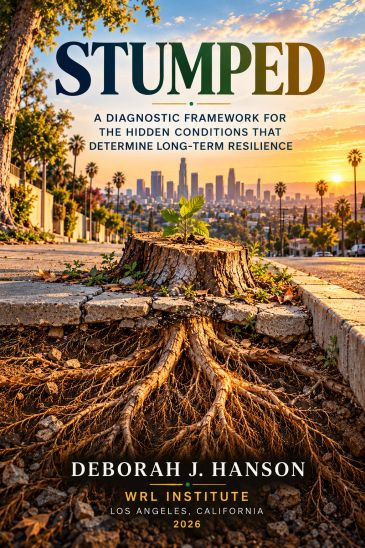
Wildfire Resilient Landscapes was founded in response to observable changes in the urban and ecological fabric of Los Angeles. Over time, a consistent pattern emerged: mature trees removed and left as stumps, declining canopy cover, and the gradual loss of shade that once moderated neighborhood environments. These localized changes reflect broader systemic pressures shaping urban heat, ecological stability, and landscape continuity.
Deborah J. Hanson is the Founder of Wildfire Resilient Landscapes, a systems-focused initiative examining how environmental resilience is shaped by the interaction of ecological systems, infrastructure, and public governance. Her work focuses on identifying structural gaps in how landscapes are maintained, renewed, and adapted under increasing environmental stress.
She holds a Master of Public Administration from California State University, Northridge, where her work focused on nonprofit systems, governance, and financial sustainability, and a Bachelor of Arts in Anthropology from the University of California, Los Angeles. Her research and writing explore urban canopy regeneration, fire-adapted landscapes, and the institutional conditions required to support long-term resilience.
Wildfire Resilient Landscapes advances a systems-based approach to landscape regeneration, integrating policy analysis, ecological design, and governance frameworks. Current work includes the development of the Urban Tree Renewal for Resilience framework and related policy research addressing canopy decline, wildfire risk, and long-term landscape performance.
What began as noticing tree stumps in neighborhood landscapes has evolved into a broader effort to understand and strengthen the systems that shape how communities adapt to environmental change.
We use cookies to analyze website traffic and optimize your website experience. By accepting our use of cookies, your data will be aggregated with all other user data.